
 Pilot Training in Indian Flying school (DGCA CPL)
While training abroad offers speed, pursuing a Commercial Pilot License (CPL) through an Indian flying club or Flight Training Organisation (FTO) provides the direct path to employment in the rapidly expanding domestic aviation market. The primary advantage of training in India is the elimination of the complex license conversion process and the immediate familiarity with DGCA regulations and Indian airspace, which is essential for working with local carriers. Furthermore, students benefit from a familiar culture and can often leverage government-approved education loans more easily for DGCA-approved courses. However, prospective pilots must contend with significant challenges, including potential delays—which can stretch the 10-18 month course into 2-3 years—due to a confluence of factors like limited aircraft availability, maintenance backlogs, seasonal weather disruptions (monsoon), and high competition for available flying slots. Despite the longer timeline and competitive costs (often ₹35 Lakh to ₹55 Lakh), training in India provides a localized expertise and a direct route to securing a position as an Indian airline pilot.
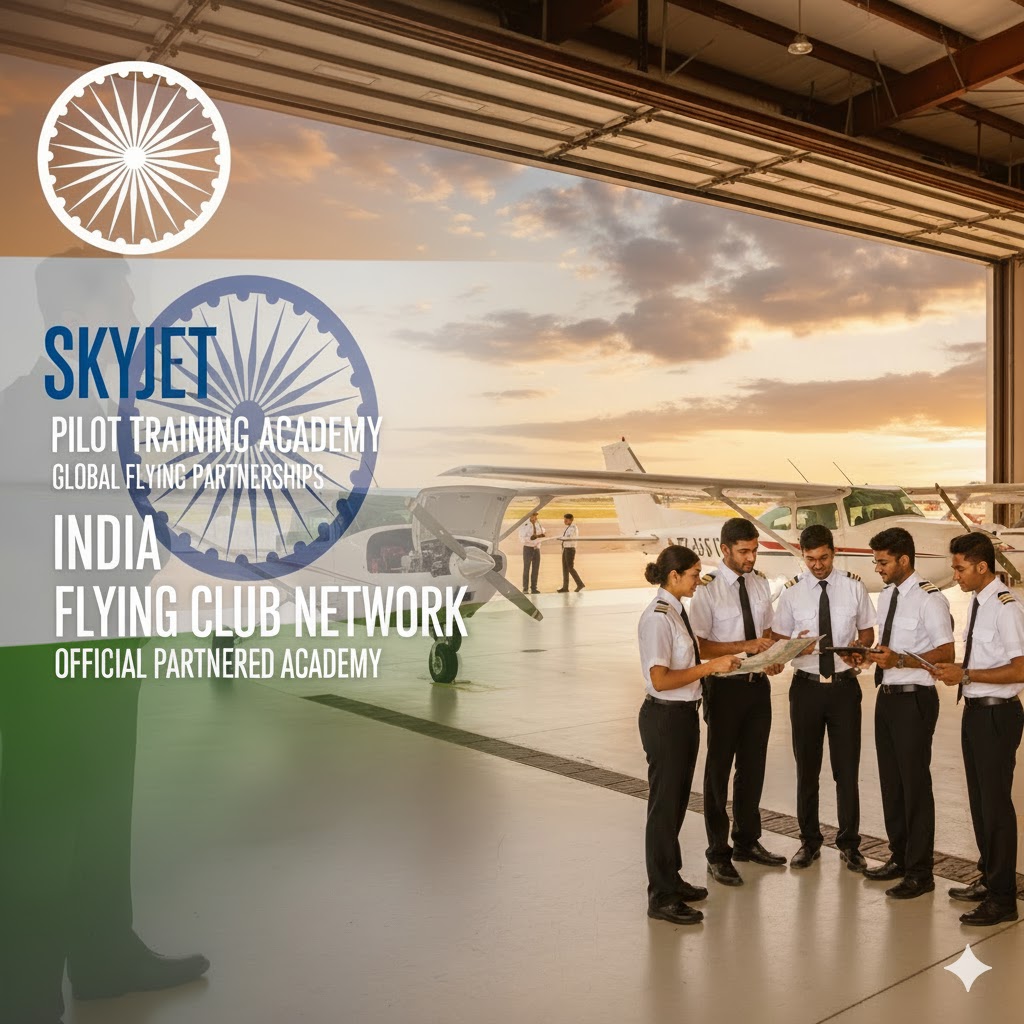
Embarking on a career as a pilot is a dream pursued with passion, precision, and dedication. Here is the step-by-step, detailed guide to becoming a Commercial Pilot in India under the regulations of the Directorate General of Civil Aviation (DGCA).
Vande Bharat! Let your journey take flight!
Phase 1: Preparation and Medical Fitness (The Foundation)
Step 1: Meet the Educational Criteria
This is the non-negotiable academic foundation.
- Qualification: Must have passed
(Higher Secondary) or an equivalent examination.
- Mandatory Subjects: Physics and Mathematics are compulsory.
- What if I didn’t have PCM in
? You can still qualify by passing the required subjects from an open board like NIOS (National Institute of Open Schooling) or any recognized board.
- Age: Minimum age to start training is 17 years.
Step 2: Obtain the Initial Medical Certificate (Class 2)
Medical fitness is paramount in aviation. You must prove you are physically and mentally fit to fly.
- Requirement: The Class 2 Medical Certificate is the first official medical clearance.
- Process:
- Register on the DGCA’s eGCA portal and apply for a Computer Number.
- Book an appointment with a DGCA-approved Class 2 Medical Examiner.
- Undergo a battery of tests: General physical check, vision test, hearing test, basic blood/urine tests, and an ECG.
- Outcome: Once cleared, you will receive your initial medical certificate, which is a prerequisite for your Student Pilot License.
Step 3: Obtain the Final Medical Certificate (Class 1)
This is the most stringent medical clearance, mandatory for a Commercial Pilot License (CPL).
- Requirement: The Class 1 Medical Certificate is required before or early in your CPL training.
- Process: Conducted only at DGCA-approved medical centers (often Air Force establishments like AFCME, IAM, etc.).
- Tests: This involves a much more detailed and extensive examination, including specialized tests for Ophthalmology, ENT, Cardiac Health (ECG, Treadmill Test, Echocardiography), Lung Function, and detailed lab work.
- Validity: This certificate must be renewed periodically (usually annually or semi-annually after a certain age) to keep your license current. No current Class 1 Medical means no flying commercially.
Phase 2: Ground Training and Licensing
Step 4: Secure Admission and Get Your Student Pilot License (SPL)
- Enrollment: Join a DGCA-approved Flying Training Organization (FTO) or Flying Club. Research reputation, aircraft fleet, and safety record carefully.
- Student Pilot License (SPL): After enrollment, you will clear a simple written or oral test conducted by the Chief Flying Instructor (CFI) on subjects like Air Regulations and Navigation to get your SPL. This permits you to fly under the supervision of a certified instructor.
Step 5: Complete Ground School and Clear DGCA Theory Exams
This is the most academically intensive part. You must clear all written exams conducted by the DGCA before you can be issued a CPL.
| DGCA Subject | Focus Area |
| Air Regulations | Rules of the Air, Aircraft Rules, procedures for Indian and International airspace. |
| Aviation Meteorology | Understanding weather phenomena, decoding weather reports, and its impact on flight. |
| Air Navigation | Principles of map reading, flight planning, instrumentation, and radio navigation aids. |
| Technical General | General knowledge of aircraft systems, aerodynamics, engines, and principles of flight. |
| Technical Specific | Specific technical knowledge of the aircraft type you will train on (e.g., Cessna 172). |
| Radio Telephony (RTR-A) | A separate exam and practical test on proficiency in aviation communication with Air Traffic Control (ATC). |
- Schedule: DGCA exams are held four times a year. Most aspirants attend dedicated ground classes to prepare, as the syllabus is vast and the passing standards are high.
Phase 3: Flight Training (The Core)
Step 6: Accumulate Required Flight Hours
Your practical training begins after, or in parallel with, your ground schooling. The minimum requirement for a CPL is 200 hours of total flight time, as mandated by the DGCA.
| Type of Flight Time | Minimum Requirement | Purpose |
| Total Flight Time | 200 Hours | Overall experience. |
| Pilot-in-Command (PIC) | Time spent flying the aircraft solo, taking full responsibility. | |
| Cross-Country PIC | Flying alone over long distances, requiring detailed navigation and planning. | |
| Instrument Time (IR) | Flying using only aircraft instruments (no external visual cues), mandatory for the Instrument Rating (IR). | |
| Night Flying | Operating the aircraft during night conditions. |
Step 7: Acquire Essential Ratings (IR and ME)
You need endorsements on your license to fly commercial airliners:
- Instrument Rating (IR): Certifies you to fly under Instrument Flight Rules (IFR), essential for flying in poor visibility and with the air traffic control system. This is completed during your 200 hours.
- Multi-Engine Rating (ME): Certifies you to fly aircraft with more than one engine (standard for almost all commercial airliners). This involves a few extra hours of flight training on a multi-engine aircraft.
Phase 4: Commercial Pilot License (CPL) and Career
Step 8: Apply for and Receive Your CPL
- Once you have:
- Cleared all DGCA written exams.
- Completed the mandatory 200 hours of flight time.
- Possess a valid Class 1 Medical Certificate.
- Cleared the RTR (Aero) practical test.
- You submit all documentation and logbooks to the DGCA. Upon verification, the DGCA will issue your Commercial Pilot License (CPL), making you eligible for professional flying jobs.
Step 9: Get the Type Rating (The Job-Specific Training)
This is the final, most specialized, and often the most expensive training phase.
- What it is: Training to fly a specific type of jet used by airlines (e.g., Airbus A320, Boeing 737).
- Process: It involves rigorous training, primarily on a full-flight simulator, lasting 2-3 months.
- Hiring: Most candidates either pay for the Type Rating themselves or get selected for an airline’s Cadet Pilot Program, where the airline sponsors or finances the Type Rating in exchange for a service bond.
Step 10: Airline Recruitment and Career Growth
- Application: Apply to domestic and international airlines.
- Selection: This typically involves:
- Aptitude and Written Technical Test.
- Psychometric/Compass Test.
- Panel Interview (Technical and HR).
- Simulator Assessment: A final check on your flying skills and decision-making under pressure.
- Initial Role: You start as a Junior First Officer (Co-Pilot).
- Progression: After thousands of flight hours and passing the final required theoretical exam (the Airline Transport Pilot License or ATPL), you are eligible for promotion to Captain (Pilot-in-Command).