
 CPL in the USA for Indian Students: The Complete Guide
The path typically involves obtaining a FAA (Federal Aviation Administration) CPL in the USA, followed by the mandatory DGCA (Directorate General of Civil Aviation) license conversion process upon returning to India.
1. Why Choose the USA for CPL Training?
| Feature | Benefit for Indian Students |
| Speed | Training can often be completed in 8 to 12 months, compared to 18–24 months in some other countries, primarily due to better, more consistent flying weather. |
| Quality & Standards | Training is highly standardized under the FAA, with excellent infrastructure, modern aircraft, and state-of-the-art simulators. |
| Global Recognition | The FAA license is recognized worldwide (it is ICAO compliant), providing a strong foundation for a global career. |
| Post-Training Options | The F-1 Visa (if offered by the school) can allow for post-training work authorization (like working as a Flight Instructor) to build the required 1500 hours for an Airline Transport Pilot License (ATPL). |
2. Eligibility & Prerequisites
| Requirement | Details |
| Age | Minimum 17 years to start PPL, and 18 years to apply for the CPL. |
| Education | Must have passed 10+2 (Higher Secondary) with Physics and Mathematics as mandatory subjects. |
| Medical | Must obtain an FAA Class 2 Medical Certificate to begin CPL training (and eventually a DGCA Class 1 Medical for conversion/working in India). |
| English Proficiency | Must demonstrate proficiency. No formal IELTS/TOEFL is always mandatory to start flying, but excellent command of English is required for the visa and all communication. |
3. The CPL Training Process (FAA License)
The US typically follows a modular approach:
- Private Pilot License (PPL): The first step. Teaches basic flying skills and is primarily for personal use.
- Instrument Rating (IR): Qualifies the pilot to fly under Instrument Flight Rules (IFR) in low visibility.
- Commercial Pilot License (CPL): The final step, requiring a minimum of 250 total flight hours (Part 61) or less (Part 141), with specific cross-country, night, and PIC (Pilot-in-Command) minimums.
- Multi-Engine Rating (MEL): Required for flying commercial twin-engine aircraft.
4. Visa & Security Clearance Requirements
Indian students require two main clearances:
| Clearance Type | Purpose & Details |
| M-1 Student Visa | The vocational student visa used for pilot training. You must receive a Form I-20 from a SEVP-approved flight school to apply for this visa. Note: Some flight schools with college programs may offer the F-1 visa, which has better post-training work options (OPT). |
| SEVIS Fee | A mandatory fee paid to the Student and Exchange Visitor Information System (SEVIS) after receiving the I-20 form. |
| TSA Clearance | All non-U.S. citizens must complete a background check through the Transportation Security Administration (TSA) Alien Flight Student Program (AFSP) before beginning any flight training. |
5. Cost and Duration (Estimated)
- Total Cost (CPL + Ratings): Approximately $60,000 to $90,000 USD (₹50 Lakh to ₹75 Lakh), depending on the flight school, aircraft used, and student efficiency.
- Living Expenses: Add roughly $1,000 – $1,500 USD per month for accommodation, food, and transport.
- Duration: 10 to 12 months (Full-time dedication and good weather are key).
6. FAA to DGCA Conversion (Mandatory to work in India)
To work as a pilot for an Indian airline, your FAA CPL must be converted into a DGCA CPL.
This is the final, crucial step:
| Step | Requirement |
| DGCA Theory Exams | Must clear three DGCA theory papers (Air Regulations, Composite Navigation, and Meteorology) if not already cleared in India. |
| DGCA Class 1 Medical | Must hold a valid Indian DGCA Class 1 Medical Assessment. |
| Logbook & Hours | Your FAA logbook must meet specific DGCA minimums (e.g., 200 Total Hours, 100 PIC, 50 Cross-Country, 10 Multi-Engine, etc.) and be correctly verified. |
| Skill Test (Check Ride) | A proficiency check (flight test) conducted by a DGCA-approved examiner on an Indian-registered aircraft. |
| RTR (A) Licence | Must obtain the Indian Radio Telephony Restriction (Aeronautical) license, which is conducted by the WPC. |
The conversion process typically takes 3 to 6 months after returning to India. Many students complete their DGCA Ground School in India before they travel to the USA for flight training to save time.
Flight training
Each year, the number of Indian students participating in pilot training in America has steadily increased and the country has become the most preferred destination for obtaining your commercial pilot licence. Flight training in the USA is highly regarded worldwide, thanks to its well-established aviation infrastructure with a multitude of flight schools and training facilities, students have a wide array of options to choose from.
The USA’s extensive airspace and various climate conditions allow for comprehensive training experiences, while the country’s adherence to strict safety regulations ensures that aspiring pilots receive top-quality instruction and gain the skills needed for successful careers in aviation.
Weather for Flight Training
Weather for flight training in the USA varies significantly due to its vast size and geographical diversity. Pilots can experience a wide range of conditions, from clear skies in the desert Southwest to challenging winter weather in the Northern states. This diversity allows aspiring aviators to develop the skills needed to navigate through various climates and terrains. The USA’s well-developed meteorological services and advanced technology provide essential weather data, ensuring safety and comprehensive training for future pilots.
Living in USA
Living, studying and working in the US gives students the exposure and the confidence that very few other countries are able to offer. Living in the United States means you will be able to enjoy interacting and engaging with a huge and diverse population that is a mix of different cultures, nationalities and people. Your time studying in the USA will not only give you access to some of the most professional and respected instructors but it is also incredibly cost-effective. Your pilot training courses will be taught by highly experienced and qualified instructors who will enhance your knowledge and skill.
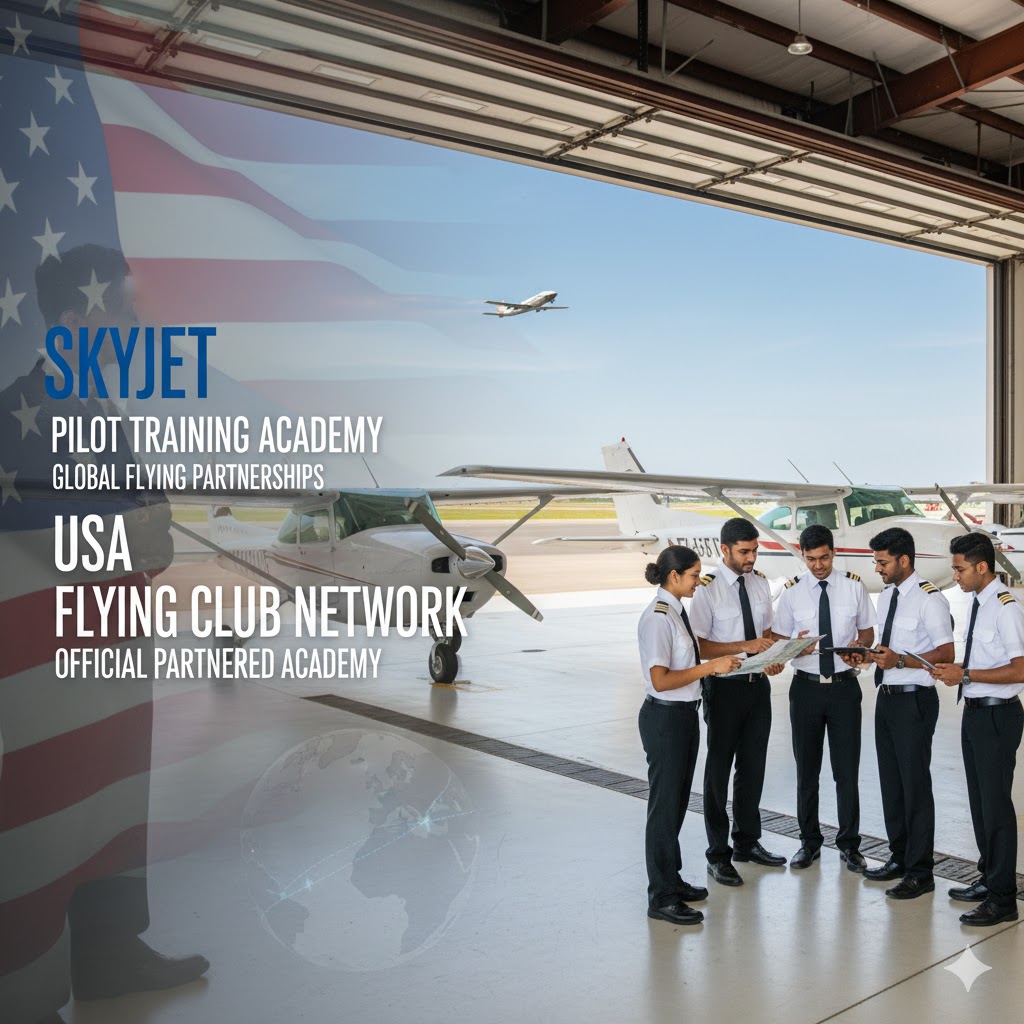
 Our Global Flying Advantage: The 11+ USA Club Network
“At Skyjet Pilot Training Academy, your training isn’t restricted to a single location. We have forged exclusive partnerships with over 11 top-tier FAA-approved Flying Clubs across the United States to deliver a superior, flexible, and accelerated flying experience.”
“Top-Notch FAA Instruction. Seamless DGCA Conversion Support.”
The Power of Partnership
We eliminate the delays that often hinder pilot journeys by giving you unparalleled access to a vast network of dedicated training facilities.
| Feature Highlight | Benefit to the Student |
| Guaranteed Flight Slots | With access to over 11 clubs, you benefit from a significantly larger pool of aircraft and instructors. This minimizes downtime and ensures a faster path to reaching your 200-hour CPL requirement. |
| Diverse Aviation Experience | Train in varied weather conditions and airspace across different states—from the busy metropolitan areas to dedicated training zones—giving you a well-rounded, robust flying skillset that airlines look for. |
| Best-in-Class Fleet | Our partner clubs maintain modern, advanced fleets of both single-engine and multi-engine aircraft, guaranteeing you train with the highest standards of safety and technology. |
| Cost & Time Efficiency | By strategically placing students where conditions and resources are optimal, we ensure your training is efficient, helping you complete your CPL faster and with predictable costs. |
| Exclusive Skyjet Support | Even while flying in the USA, you remain a Skyjet Cadet. We provide continuous support for visa renewals, accommodation, and, most critically, logbook verification for smooth DGCA conversion. |
Talk to our counselors today to discover the perfect USA Flying Club location for your CPL journey!